Hawaii LIHTC guide: how a project moves through HHFDC, from application to placed in service
A step-by-step guide to Hawaii's low-income housing tax credit process: the HHFDC Consolidated Application, threshold review, scoring, award to closing, and placed in service, with 2026 round dates, QAP thresholds, and what actually sets your schedule.
Contents
- Hawaii LIHTC in one page
- What actually sets your schedule: the building permit
- Before you apply: three site checks
- Stage 1: The round opens (about 2 months before the deadline)
- Stage 2: Intake and threshold review (1 to 2 weeks)
- Stage 3: Scoring, review and the Board award (3 to 5 months)
- Stage 4: From award to closing (6 to 12 months)
- Stages 5 and 6: Closing, construction draws and placed in service (2 to 3 years)
- Timeline at a glance
- Mistakes that cost a round
- Hawaii LIHTC: frequently asked questions
- Primary sources
A Hawaii LIHTC project takes roughly three to four years to go from the day HHFDC opens its funding round to the day the last building is placed in service. How fast a project gets through that path depends less on HHFDC than on how ready the applicant is, and above all on how quickly the building permit is in hand.
This guide walks through that path one stage at a time, from the developer’s side of the table. It is built on the workflow HHFDC’s multifamily finance staff use to move an application from intake to disbursement. I worked in that section, drafting the Qualified Allocation Plan and underwriting applications, and I now file applications against it as a developer.
The guide reflects the 2026 funding round and the 2026 QAP. HHFDC has not yet published a 2027 round; check its Consolidated Application page before relying on any date here.
Hawaii LIHTC in one page
Hawaii’s low-income housing tax credits are allocated by HHFDC, and many Hawaii LIHTC deals also draw on HHFDC’s bond and loan programs. The four pieces a developer works with:
| Program | What it is | How it is awarded |
|---|---|---|
| 9% LIHTC | Federal credits from Hawaii’s capped annual allocation | Competitive, scored under the QAP |
| 4% LIHTC | Federal credits paired with tax-exempt bond financing | Not scored; limited by the State’s bond cap |
| Hula Mae Multi-Family (HMMF) | HHFDC’s tax-exempt revenue bond program | Through the Consolidated Application |
| Rental Housing Revolving Fund (RHRF) | State loans for rental housing | Through the Consolidated Application |
All four are requested in a single Consolidated Application, and all of them move through the same six stages below.
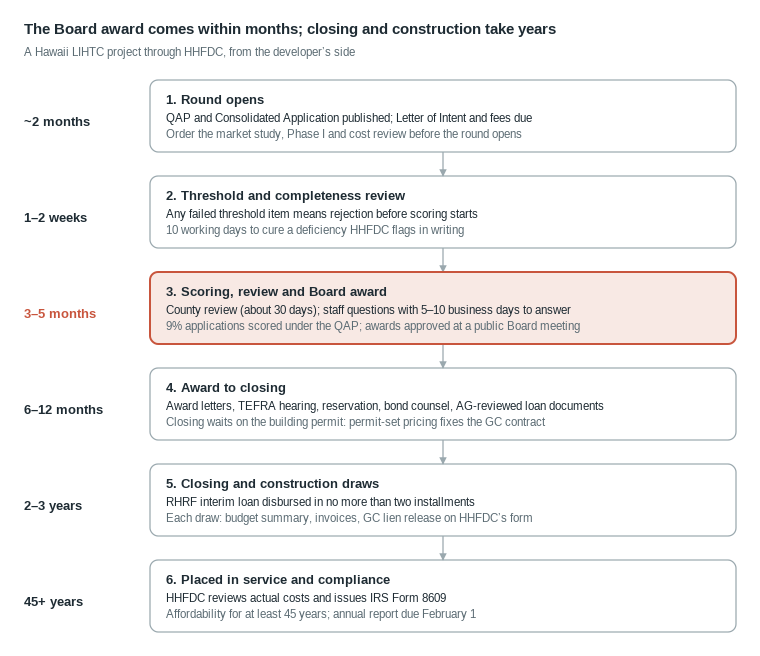
The left column is the typical duration of each stage. Stage 3 is where an application becomes an award; the stages after it are where most of the calendar goes.
What actually sets your schedule: the building permit
The biggest driver of a Hawaii LIHTC timeline is not HHFDC’s internal process. It is how ready the applicant is, and of everything a financial closing needs, the building permit is almost always the last item in hand.
The reason is the chain behind it:
- Permit-set drawings are the only drawings an accurate cost estimate can be priced from.
- That estimate is what lets you fix the general contractor’s price.
- The GC contract is what lenders, investors and HHFDC size the final deal on.
- Closing happens only once that number is fixed.
An estimate priced from earlier drawings moves when the permit set changes, and the GC price moves with it. So how fast you close depends mostly on how fast you get the building permit. Start the permit drawings and county review as early as you can afford to, ideally before the award.
Before you apply: three site checks
Of all the minimum thresholds, site control comes first: without land to develop there is no project. Choosing that land takes judgment I will cover in a separate article. These are the three things to check before anything else.
- Utilities: Electricity, Water, Sewer. Because Hawaii is an island state, utility problems come up far more often here than in large cities elsewhere, and they are worse on the neighbor islands. When they do, they can take an enormous amount of time and can cost enough to end a project. A small substation for an electrical connection can take one to two years in some cases. A sewer line in a given area may lack capacity and have to be upsized. A site without water may need a well, and finding one can take a long time. If a well-located parcel is priced below its neighbors, suspect utilities first, and confirm electricity, water and sewer capacity as soon as you secure the site.
- Entitlements, which are more flexible than the zoning map suggests. Current zoning and density are not the final limit. Honolulu’s Bill 7 affordable rental program (extended through May 21, 2031), Chapter 201H exemptions and partnering with DHHL can each overcome part of it. Knowing how to apply these incentives is one of the biggest advantages in buying land, and it can let you buy a site for far less than its potential value.
- The basis boost: does the site qualify for 130%? A project in a HUD-designated Qualified Census Tract or Difficult Development Area can claim up to 130% of eligible basis. Without it, a site that works on every other count may not generate enough credit to be feasible, or may score lower against projects that have it. HUD updates the designations every year, so check the current QCT and DDA maps before you commit.
Stage 1: The round opens (about 2 months before the deadline)
HHFDC opens one Consolidated Application round a year, usually in December, with the application due about two months later. The 2026 round opened on December 19, 2025 and closed on February 20, 2026.
Two documents define the round:
- The Qualified Allocation Plan (QAP). It sets the threshold rules, the scoring criteria for 9% credits, the developer fee caps and the affordability commitment. HHFDC holds a public hearing on each new QAP; the 2026 QAP was heard on July 30, 2025.
- The Consolidated Application. One application covers LIHTC, Hula Mae Multi-Family (HMMF) tax-exempt bonds and Rental Housing Revolving Fund (RHRF) loans. You request every source you need in the same filing.
What the developer does in this window, using the 2026 round as the example:
- File a Letter of Intent with full fees. New for 2026: the LOI and a cashier’s check for the program fees were due by certified mail on January 16, 2026. Miss it and you are out of the round.
- Attend the portal training. Applications now go through the Procorem portal, and the training on January 21, 2026 was mandatory.
- Assemble the threshold package. The items that take longest to commission are a market study (dated within six months of the deadline), a Phase I report (within one year), a preliminary engineering report and a third-party cost review.
- Submit by the deadline. 2:00 p.m. HST on February 20, 2026, through Procorem.
The practical point: the two months after the round opens are too short to start from zero. Site control, zoning and the third-party reports need to be under way in the fall.
Stage 2: Intake and threshold review (1 to 2 weeks)
In the first one to two weeks, HHFDC checks two things before any scoring starts: whether a LIHTC application meets every minimum threshold, and whether each application is complete. Failing a threshold item means immediate rejection under the QAP.
The 2026 QAP thresholds that most often decide whether an application survives:
| Threshold | 2026 QAP requirement |
|---|---|
| Site control | Leases must run at least 5 years past the affordability period |
| Readiness | Zoning and Special Management Area approvals, as applicable |
| Debt service coverage | At least 1.15x, with a 5% minimum vacancy and $300/unit/year minimum replacement reserve |
| Contractor profit, overhead, general requirements | Capped at 14% of hard costs |
| Developer fee (9%, new construction) | $55,000 per unit or $4,750,000, whichever is less |
| Affordability | At least 45 years, with the qualified contract option waived |
| Experience | At least one LIHTC project placed in service by the applicant or an affiliate |
If HHFDC finds a deficiency it sends written notice, and the applicant has ten working days to correct it. That window is for fixing a gap, not for producing a report that was never ordered.
Stage 3: Scoring, review and the Board award (3 to 5 months)
Scoring takes three to five months and ends with HHFDC’s Board of Directors approving awards at a public meeting. Only 9% applications are scored; bond-financed 4% projects are not subject to the QAP point system, but they still go through the same review and Board approval.
What happens in this stage, and where the developer is pulled in:
- Copies go out for review. HHFDC sends the application to its development staff and to the county where the project sits. Counties are given about 30 days to respond.
- Questions come back to you. Staff send written questions and typically allow 5 to 10 business days for answers. Slow or incomplete answers cost you; this is the step where a strong application can look unready.
- Underwriting. Staff cross-check the application and run the financial analysis: sources and uses, costs against limits, and how much credit or loan the project actually needs.
- Preliminary award list. Staff report a preliminary list of awards to the Executive Director, then publish the approved and rejected list and draft the recommendation for the Board, which takes about 30 days.
- Final clarifications. A last round of questions to close any open items before the Board meeting.
- Board meeting. Staff present the recommended awards, and developers are typically asked to present their projects.
For 9% applications, the 2026 QAP points are concentrated in a few criteria:
| Criterion (2026 QAP) | Maximum points |
|---|---|
| Applicant readiness | 24 |
| Reasonableness of development costs | 12 |
| Resource efficiency and leveraging | 10 |
| Developer and property management experience | 10 |
| Income targeting | 10 |
| Length of affordability | 7 |
| Location and market demand, plus transit | 6 + 3 |
| State or local government financing | 5 |
| State- or county-owned land | 5 |
| Unit sizes and bedroom mix | 5 |
| County adjuster | 2 |
Stage 4: From award to closing (6 to 12 months)
A Board award is a commitment, not money. The six to twelve months after it are spent turning each award into a closing, and for bond-financed deals this is the longest and most document-heavy stage.
- Preliminary award letters. You receive a separate letter for each source awarded: RHRF, HMMF bonds, LIHTC. Unsuccessful applicants receive rejection letters.
- TEFRA hearing (bond deals only). Federal law requires a public hearing within one year before tax-exempt bonds are issued. HHFDC drafts the notice and confirms it with the developer, posts it on its website and the State calendar at least 7 days before the hearing, holds the hearing and files the notice, sign and minutes.
- LIHTC reservation letter. HHFDC issues the formal reservation of credits. Under the 2026 QAP, a good faith deposit of 10% of the first-year federal reservation is due with the executed binding agreement.
- Approval to issue bonds and release RHRF funds. The State approves the intent to issue the revenue bonds, which triggers the assignment of bond counsel, and approves the release of RHRF program funds.
- Bond counsel and bond sale. Bond counsel is assigned, the bond structure is set and the bonds are sold.
- Loan documents. HHFDC circulates the RHRF loan documents, the developer’s attorney returns redlines, the Attorney General’s office reviews and approves them, final documents are produced and routed for signature and notarization, and the recordable documents go back to the developer’s attorney.
Two federal clocks start running in this stage for 9% deals. A carryover allocation requires you to spend more than 10% of the project’s reasonably expected basis within 12 months, and the buildings must be placed in service by the end of the second calendar year after the allocation year.
For 4% deals, the bond test changed in 2026. The One Big Beautiful Bill Act cut the share of aggregate basis that must be financed with tax-exempt bonds from 50% to 25%, for bonds issued after December 31, 2025. HHFDC’s 2026 round caps HMMF tax-exempt financing at no more than 30% of aggregate basis. I cover what that means for Hawaii’s bond cap in The 25% bond test.
Stages 5 and 6: Closing, construction draws and placed in service (2 to 3 years)
From closing to placed in service usually takes two to three years, most of it construction. HHFDC’s role shifts from underwriting to disbursing loan funds and then to monitoring compliance.
Closing and draws. After closing, HHFDC sets up the project to receive payments and forwards the contract summary to the State’s fiscal staff. Under the 2026 round, RHRF interim loans are disbursed in no more than two installments during construction, at HHFDC’s discretion. A disbursement request typically carries:
- a cover memo and cover letter
- the RHRF draw status and construction budget summary
- an invoice summary and copies of the invoices
- a general contractor lien release on HHFDC’s own form
HHFDC expects the lien release on its own form, not the contractor’s.
Placed in service. When the buildings are complete, HHFDC reviews the project before issuing IRS Form 8609, the form that lets the owner claim credits. HHFDC verifies compliance at that review and can reduce credits if actual costs came in lower than projected. The restrictive covenant must already be recorded before credits are allocated.
Compliance. The federal compliance period is 15 years, followed by an extended use period. Hawaii’s 2026 QAP requires an affordability commitment of at least 45 years, and awards extra points for longer commitments, up to perpetuity. Compliance monitoring fees start on the placed-in-service date of the first building, and annual reports are due February 1.
Timeline at a glance
Added up, a 9% project that applies in February can expect a Board award by mid-year, a closing six to twelve months after that, and its first buildings in service two to three years after closing.
| Milestone | Typical timing | 2026 round or rule |
|---|---|---|
| Round opens | About 2 months before the deadline | December 19, 2025 |
| Letter of Intent and fees | About 5 weeks before the deadline | January 16, 2026 |
| Application deadline | — | February 20, 2026, 2:00 p.m. HST |
| Threshold and completeness review | 1 to 2 weeks after the deadline | 10 working days to cure a deficiency |
| Scoring, review and Board award | 3 to 5 months | Board approval at a public meeting |
| Award to closing | 6 to 12 months | TEFRA hearing within 1 year before bond issuance |
| 10% test (9% carryover) | Within 12 months of the allocation | Federal rule |
| Placed in service | 2 to 3 years after closing | By the end of the 2nd calendar year after the allocation year |
| Affordability | — | At least 45 years under the 2026 QAP |
The durations are typical ranges from HHFDC’s own workflow, not guarantees. The item that most often sets the closing date is the building permit, because the final GC price depends on the permit-set drawings.
Mistakes that cost a round
Most Hawaii LIHTC applications that fail do so on preparation, not on the project itself. The ones I see most often:
- Buying a cheap site without checking utilities. A parcel priced below its neighbors often has a sewer capacity or connection problem, especially on the neighbor islands.
- Starting permit drawings after the award. The building permit is usually the last closing item, and every month it slips moves the closing with it.
- Ordering third-party reports after the round opens. The market study, Phase I and cost review have dating windows and lead times that do not fit inside two months.
- Missing the Letter of Intent. Since 2026 the LOI and full fee payment come about five weeks before the application. There is no late filing.
- A pro forma below QAP minimums. Vacancy under 5%, reserves under $300 per unit per year or coverage under 1.15x fail threshold before scoring starts.
- A ground lease that is too short. The lease must run at least five years past the affordability period, which is 45 years at minimum.
- No placed-in-service experience on the team. The applicant or an affiliate needs at least one LIHTC project already in service. First-time developers usually partner to meet this.
- Slow answers during scoring. Questions come with 5 to 10 business days to respond. A late or vague answer reads as an unready project.
- Treating the award as funding. Reservation, deposit, bond approval, bond counsel and loan documents still sit between the Board vote and a closing.
- Letting the TEFRA hearing go stale. The hearing must fall within one year before the bonds are issued. If closing slips past that year, the hearing has to be held again.
Hawaii LIHTC: frequently asked questions
Who allocates LIHTC in Hawaii? The Hawaii Housing Finance and Development Corporation (HHFDC), under the State’s Qualified Allocation Plan. Applications go through its annual Consolidated Application.
How much 9% credit does Hawaii receive? For 2026, each state receives $3.416 per resident or $3,953,600, whichever is greater, under Rev. Proc. 2025-32. The figure includes the 12% increase enacted in the One Big Beautiful Bill Act. HHFDC’s own 2026 exhibits put Hawaii’s total 9% volume cap at about $7.4 million.
What is the difference between 9% and 4% credits? 9% credits come from the capped annual allocation and are awarded competitively by QAP score. 4% credits come with tax-exempt private activity bonds and are not scored; the limit is the State’s bond cap, which for Hawaii is the small-state minimum of $397,625,000 in 2026.
When is the next HHFDC funding round? HHFDC has not yet published a 2027 round. Recent rounds have opened in December with applications due in February. I track what has and has not been released in Hawaii’s 2027 LIHTC round.
How long does a Hawaii LIHTC project take? Typically three to four years from application to placed in service: up to six months to an award, six to twelve months to closing, and two to three years of construction.
How long must the units stay affordable? At least 45 years under the 2026 QAP. Applicants who commit to longer periods, up to perpetuity, earn additional points.
Can a first-time developer apply? Not alone. The 2026 QAP requires the applicant or an affiliate to have at least one LIHTC project placed in service, and the management agent to be managing one now. First-time developers usually partner with an experienced sponsor.
Federal rules cited here (TEFRA hearing timing, the 10% test, the placed-in-service deadline) are from Internal Revenue Code sections 42 and 147(f). Durations are typical ranges, not guarantees. Verify against the source documents before relying on any of it, and treat nothing here as legal or tax advice.
Primary sources
- HHFDC — Consolidated Application for Financing 2026 (round dates, LOI and fees, Procorem, HMMF 30% basis limit, RHRF installments)
- HHFDC — 2026 Qualified Allocation Plan (final, November 14, 2025)
- HHFDC — Qualified Allocation Plan landing page (2026 QAP hearing, July 30, 2025)
- IRS Rev. Proc. 2025-32 — 2026 LIHTC per-capita and private activity bond amounts
- Housing Finance — IRS updates 2026 LIHTC state allocation ceilings (12% OBBBA increase included)
- HUD USER — QCT and DDA mapping tool (2026 and 2027 designations)
- Honolulu Star-Advertiser — Honolulu City Council advances bill aimed at expanding affordable housing (Bill 7 extended through May 21, 2031)